
Abstract
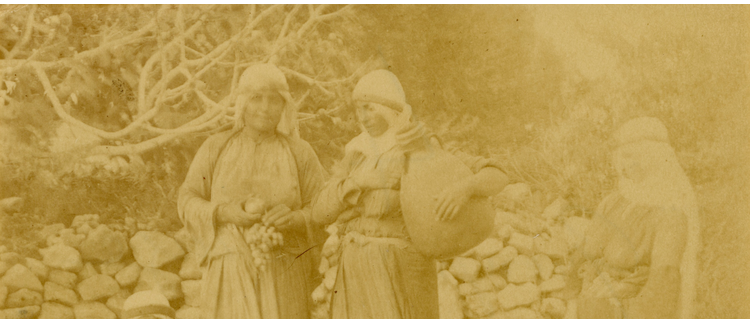
This paper examines a little-studied corpus of photographs made by Alice Oliphant, an English resident in Ottoman Palestine in the 1880s, arguing that it complicates standard Orientalist readings of photography in Palestine by foregrounding a charged, relational photographic encounter across lines of difference. At the centre of this analysis is a portrait of a Druze woman, identified here for the first time as Fooda Hassoun, with her children, taken by Oliphant in Daliat el‑Carmel in 1884–85. Rather than treating the photograph as transparent evidence or as an emblem of colonial ideology, the analysis contextualises it within the entangled dynamics of gender, empire, land, and intimacy, showing how its visual and narrative ‘opacity’ may point to history’s partial legibility and photography’s ambivalence as both record and event. Situating the scene within contemporaneous negotiations over land and status between the Oliphants and the village leadership, the article traces how asymmetric agency and strategic accommodation may coexist with moments of proximity, interruption, and co‑authorship, in a way that unsettles rigid binaries of coloniser and colonised, the kind of hybridity Bhabha terms the ‘Third Space’. By centring women’s interactions across cultural lines, the paper opens access to narratives that exceed male‑dominated accounts of territory and sovereignty, proposing late nineteenth‑century photographs of Palestine as relational artefacts whose indeterminacy illuminates complex social textures under colonial conditions.
Keywords: Alice Oliphant, Ottoman Palestine, Druze history, Palestinian photography, third space
Downloads:
Download PDF
View PDF
21 Views
2 Downloads